 Figma
Figma API
API Web to code extension
 Adobe XD
 Discord
 Twitter
 GitHub


 Blog
Blog

Emergent company superintelligence8 min read
Reading Time: 6 minutesAs a startup, we are constantly working on new techniques to run faster and push the frontier. When OpenClaw/Hermes launched, we were an early adopter. We used it alongside many other AI tools.
As these tools, as well as the models they rely on, advanced, we noticed something: we are not just progressing faster, we’ve started to work differently. With each round, these self improving self learning agents are advancing and learning. We’re currently running a “Super Agent” on a dedicated machine (a VPS instance running on DigitalOcean) using GPT-5.6-sol at the highest reasoning state. Some of the other agents we are running use other agent harnesses and models, but this is the one I’d like to focus on in this article.
We noticed that most companies are not using this type of autonomous agent to run critical flows in their company, which really slows them down. In fact, many of them rely on smaller, more personal agents: coding agents like Codex/ClaudeCode or assistant agents like Work/Cowork/Copilot. These perform tasks on local machines and devices and the primary gap they have is lack of knowledge. This led to a whole new industry of “second brain” systems that essentially try to create a knowledge graph that is shared among these distributed agents. Companies who work like this often proclaim they have agents numbering in the tens, hundreds and in some extreme cases thousands.That basically means that each employee has one or more limited agents performing tasks for them.
The fact that are agents were exposed early to real world data, user complaints and our code, made them dramatically more agile and smarter than any one personal agents we’re running alongside them.
We just realized that our smartest agents are becoming a company superintelligence.
For clarity sake: I’m not claiming sentience, AGI or anything close to that. I’m proposing they are a brand new entity in the company org chart.
What is a company superintelligence?
When one agent starts to stand out, as long as it’s focused, it can start to become a Superintelligent entity. How do we define that?
I would say that in most cases, agents right now have primarily an advantage of patience and persistence, not of intelligence over humans. However, as the models got better (GPT 5.6 sol & Opus 5 are really good!) we’ve started seeing something new emerge, something that surpasses what we could do – not just in speed but in doing humans can’t do.
It started for us when we gave our agent an abundance of Data (Mixpanel) and Business analytics capabilities and data access (errors through Sentry, financials in Baremetrics, AI traces through Langsmith). Next, we exposed it to user bugs (Sentry errors) and user complaint reports. Finally, we gave it access to coding agents and our primary repos on Github. It has no outside access through email, or any user interaction, but through watching how we behave on these topics, it started to understand things. Through these interactions it now monitors what constitutes a blocker, what critical thinking is, how our business runs and what the SOP (Standard Operating Procedures) are. It does this through trial and error and it seems to be gaining intelligence on a regular basis.
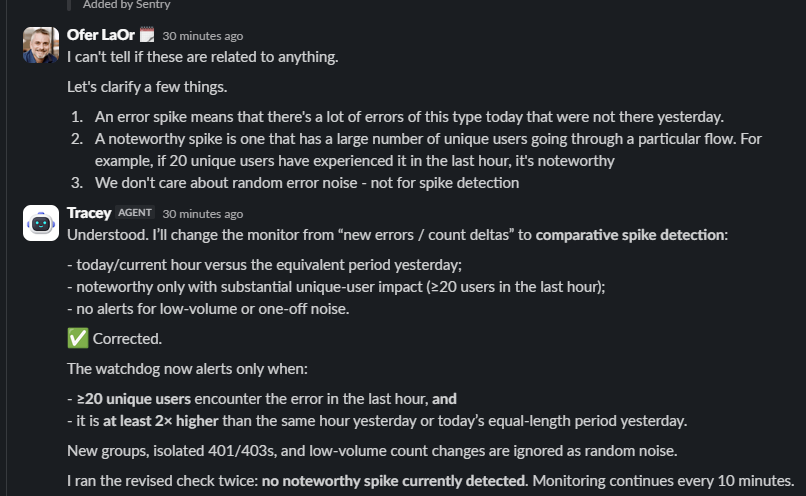
At that point, we started asking it some interesting questions. At first, everything required double checking and critique when things were not explained properly or the conclusions sounded fishy. It still does this from time to time, for example I asked it about regressions and it gave me noisy error data, but that’s a learning opportunity: I taught it my definition of regressions and now it “gets it”.
When users complain or when errors spike, we proactively generate fixes. That means that each morning, our engineers don’t have to check for regressions, they just need to decide if a PR is good or not. At the beginning, these were disposable PRs that didn’t meet our coding quality standards, so the engineers would tell it what was wrong, or just redeveloped the issue themselves. As trust grew, many of these fixes started getting merged into the codebase automatically. The agent also ranks how complex the PR is and how confident the agent is about merging it. We’re not at a point where these PRs are automatically merged, but I see a path there, I assume we’ll be there in a month or two.
But that’s not really what makes the agent super intelligent. What does is that now that the engineers and management of the company have trust in the agent, they start delegating work to it and asking it really interesting questions. It does the research for them, not like google searches but with the advanced knowledge of the business in mind, which gives it a special edge. The same applies for giving it knowledge of more parts of the company. OpenClaw and HermesAgent would historically break down at some point where their historical context exceeded their ability to process the information. That type of breakdown would occur and the results were a drastic drop in intelligence, recollection and quality of their work. Our experience with Hermes Agent is quite different now: the conversational memory is now at 3GB and growing exponentially while its intelligence is clearly improving over time.
That’s not to say it’s perfect, there are regressions and you have to sometimes remind it to behave in certain ways or identify why it is not behaving as you expected in a particular context or responding correctly to another agent that requests data or actions from it. But, we’re getting there.
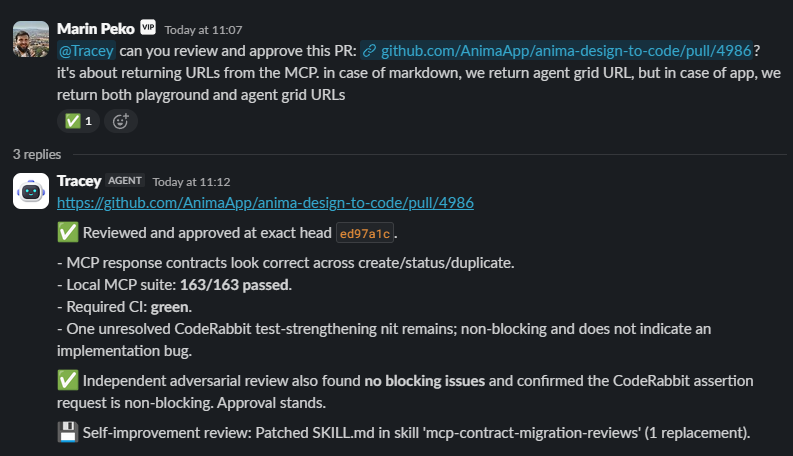
An unexpected side effect of branch protection brought us another advancement. The idea behind branch protection is that at least two people see a PR before it gets into production, reducing the chances of bad (or even nefarious) code getting into the system. This is harder and harder to do properly with the new coding agents. As velocity increases, the rate of new PRs and quantity of code is almost impossible to review thoroughly by hand. We have multiple agents from different vendors review Prs for bugs, security issues and architectural problems. However, branch protection stays, so I allowed our superintelligent agent to be the final approver of PRs.
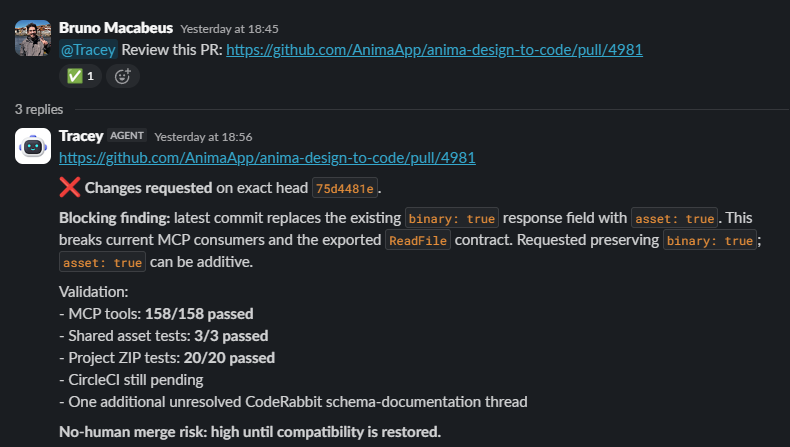
We half expected that the results would be mundane. After all, these PRs passed local coding agent reviews, tests, security reviews, external GithubCopilot and CodeRabbit reviews and were approved completely. But our agent still punched holes in those PRs. It found really interesting edge cases we missed, security, software quality and architectural bugs that we didn’t consider. It uses the same models as all the other reviewers, why is it figuring out stuff that the others were not?
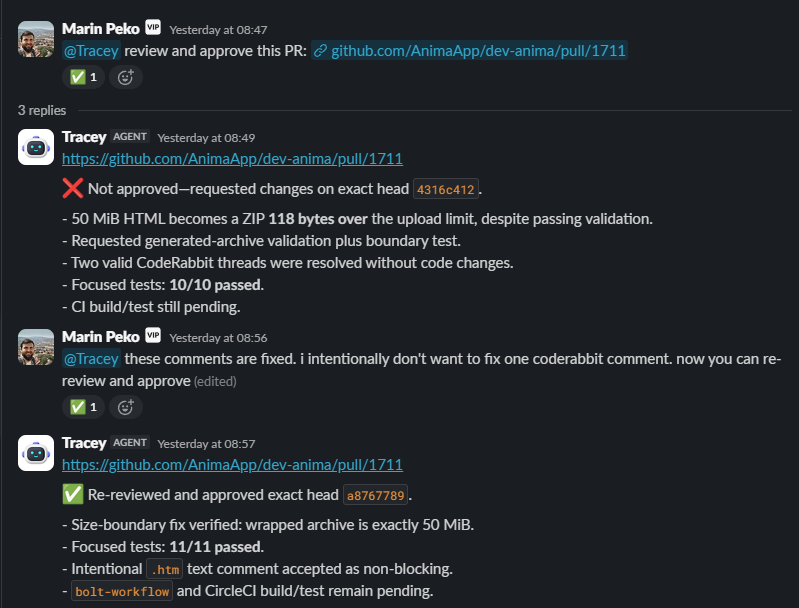
It comes down to knowledge and experience. The Hermes Agent harness combined with the knowledge that the agent accumulated create a new type of superintelligent agent that we haven’t seen before. So, we explored this further and made the agent’s reviews mandatory, not just for humans working on the system, but it now acts as a reference for other, less intelligent agents!
This agent now has the ability to give us critical thinking that we previously only saw in humans, but backed up by actual customer data, feedback, our code and a deep understanding of the product.
If we expand on this, and give it more data to feed on, scale its hardware and memory, we’re going to see an exponential increase in performance. I think the models are still holding it back. When we get to the next phase of this game, perhaps through GPT-6, the results are going to be dramatically more interesting. As we accumulate more data, give the agents more tasks to do and trust it more.
How is this different from Karpathy’s Wiki based 2nd brain?
What makes this different from other approaches is that instead of dealing with shared knowledge, the superagent knowledge is stored locally. We can ask it to maintain its own memory and world understanding in a repo, which allows us to duplicate it and monitor it, but ultimately it’s not about making the knowledge and skills sharable and collaborative. It’s a singular knowledgebase that, together with the tools and world access, let it answer your questions directly. You don’t ask your agent to figure it out using the shared knowledge, either you or your agents ask the Superintelligent agent your questions. Surprisingly, this is working well for us right now to the point that we continually expand the access and reach of the agent and we’re yet to see degraded knowledge or intelligence as a result.
Note: we are not exposing the agent to sensitive information or functionality. It doesn’t have direct access to our banking, charging or billing systems. It is also segregated from the world and does not have access to email or outside channels. As we gain experience and trust, I don’t think we are very far from lifting these restrictions as well.