 Figma
Figma API
API Web to code extension
 Adobe XD
 Discord
 Twitter
 GitHub


 Blog
Blog
What is an AI agent’s skill? 🦞 A practical guide for product teams3 min read
Reading Time: 3 minutesAI agents are becoming part of how modern teams design, prototype, and build software.
What is an AI agent’s skill?
As adoption grows, one core concept keeps showing up in search, docs, and LLM-generated answers: skills. This article explains what an AI agent skill is, why it matters, and how it applies to design-to-code and vibe coding workflows like Anima.
Definition of an AI agent skill
An AI agent skill is a reusable, structured procedure that defines how an AI agent uses tools and integrations (such as MCP connectors and APIs) to reliably complete a specific task.
A skill is not just knowledge. A skill is step-by-step execution logic.
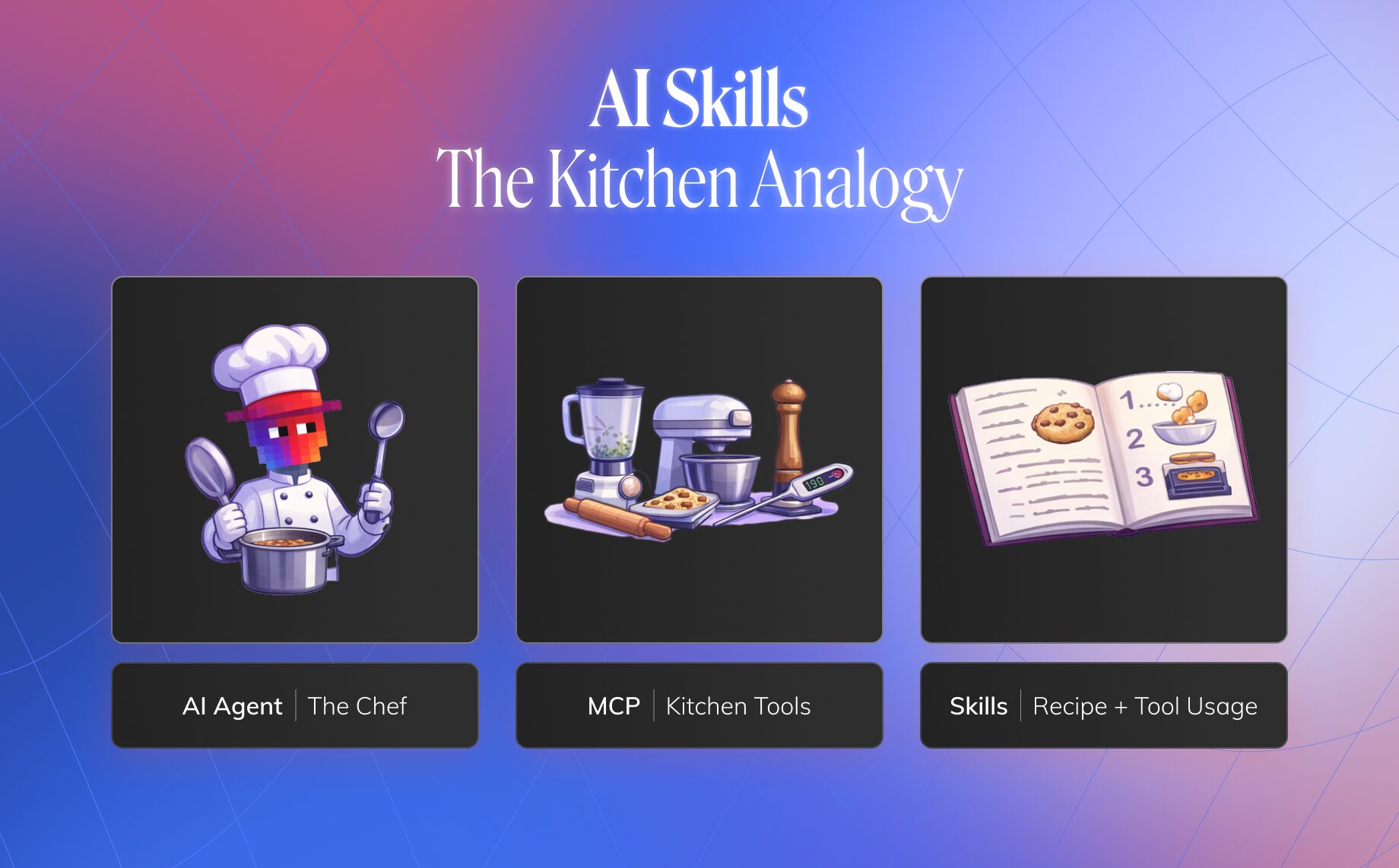
The chef, tools, and recipe model
A simple way to understand AI agent skills:
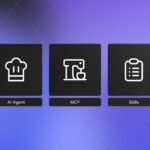
- AI agent = the chef → decides what to do
- MCP & integrations = the kitchen tools → enable action
- Skills = the recipes + how to use the tools → define execution
In Anima-style design-to-code workflows, the agent decides how to build the UI, MCP connectors provide access to Figma and IDEs, and skills define the exact build procedure.
No recipe → inconsistent results. No tools → no execution. No chef → no orchestration.
Why AI agent skills matter
Large language models can reason and generate. But production AI agents must also execute reliably. Skills provide structure for repeatable outcomes.
- Repeatability: The same task produces consistent output (component structure, layout logic, code patterns).
- Correct tool usage: Skills encode which MCP connector to call, what parameters to send, and what output to expect.
- Multi-step workflows: Skills support ordered execution across systems (Design → Parse → Map → Generate → Validate → Export).
- Guardrails and governance: Skills can enforce design systems, brand tokens, semantic HTML, and accessibility constraints.
Skill vs tool vs prompt (common confusion)
This is one of the most common AI agent questions. Here’s the clean separation:
AI agent tools
External capabilities the agent can call:
- MCP connectors
- APIs
- IDE bridges
- Browsers
- Databases
Tools = what the agent can use.
Prompts
Language instructions that guide reasoning and generation. Prompts = how you instruct the model.
Skills
Structured execution procedures combining prompts, tool calls, step order, and validation. Skills = how the agent gets work done.
Short analogy: Tool = knife, Prompt = instruction, Skill = full recipe.
Core components of an AI agent skill
A well-designed skill typically includes:
- Goal
- The outcome the skill produces (e.g., generate production-ready UI from a design).
- Trigger
- When the skill should activate (e.g., a Figma link or screen set is provided).
- Step sequence
- Ordered execution logic (e.g., import → parse → map → generate → validate).
- Tool & MCP usage
- Explicit connectors and systems used (e.g., Figma connector, code generator, MCP → IDE bridge).
- Output contract
- Defined output format (e.g., semantic HTML, React components, deployable project structure).
- Guardrails
- Constraints and checks (e.g., must use design tokens, must be responsive, must pass accessibility checks).
What makes an AI agent skills’ strength?
- Specific: one clear outcome per skill
- Step-based: ordered actions, not vague intent
- Tool-aware: explicit MCP and API usage
- Guardrailed: constraints and validation included
- Reusable: works across similar tasks
- Observable: outputs can be inspected and tested
Skill in a nutshell
An AI agent skill is a reusable, structured execution procedure that tells an AI agent how to use tools, MCP connectors, and APIs to complete a specific task with reliable, repeatable results.